Chapter 2: Theoretical Framework
Fundamentals of Cyber Defense and Smart Contract Security
2.1 Cyber Defense and Critical Infrastructure Security
2.1.1 Definition of Cyber Defense
Cyber defense is defined as the set of offensive and defensive actions, means, and procedures aimed at ensuring one's own use of cyberspace and denying it to the enemy (Joint Chiefs of Staff, 2018). In the context of modern military operations, cyberspace constitutes the fifth domain of operations alongside land, sea, air, and space (Libicki, 2009).
According to the NIST Cybersecurity Framework (National Institute of Standards and Technology, 2024), cyber defense capabilities are organized into five main functions:
Table 2.1. NIST Cybersecurity Framework Functions
| Function | Description | Application in Smart Contracts |
|---|---|---|
| Identify | Understand risk context | Digital asset inventory, dependencies |
| Protect | Implement safeguards | Access controls, input validation |
| Detect | Identify incidents | Transaction monitoring, code analysis |
| Respond | Act on incidents | Pause contracts, emergency mechanisms |
| Recover | Restore capabilities | Contract updates, migration |
2.1.2 Blockchain as Critical Infrastructure
The growing adoption of blockchain in strategic sectors such as finance, energy, logistics, and government has transformed this technology into potential critical infrastructure (Govea et al., 2024). According to Sayeed et al. (2020), blockchain systems used for:
- Decentralized Financial Systems (DeFi): With more than $50 billion in locked value
- Government Supply Chains: Traceability of strategic products
- Digital Identity Systems: Sovereign documents and credentials
- Electronic Voting: Secure democratic processes
Constitute assets whose protection is a State responsibility within the framework of national defense.
2.1.3 Relevance for National Defense
The protection of blockchain-based infrastructure has direct implications for national security (Govea et al., 2024):
"Attacks on smart contracts represent an emerging threat to nations' economic security, with losses exceeding $7.8 billion between 2016 and 2024" (Chainalysis, 2024).
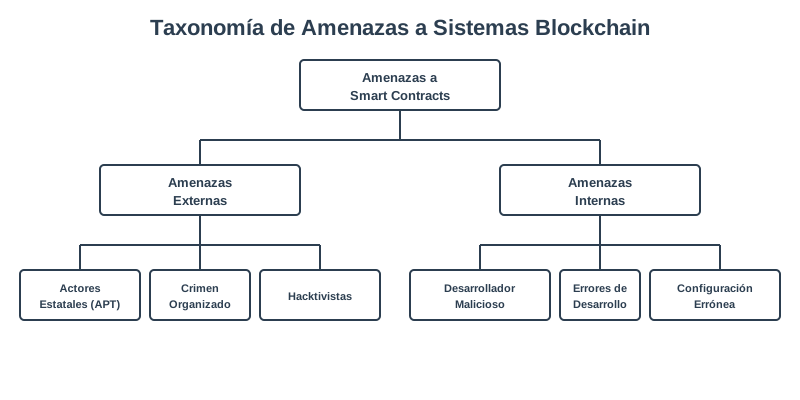
Identified threat vectors:
- State actors: APT groups capable of exploiting vulnerabilities in contracts managing sovereign assets
- Organized crime: Exploitation of vulnerabilities for money laundering
- Hacktivism: Politically motivated attacks on DeFi protocols
- Insider threats: Malicious or negligent developers
Figure 2.1. Taxonomy of threats to blockchain systems
2.2 Blockchain and Smart Contracts
2.2.1 Definition of Blockchain
A blockchain is a distributed data structure consisting of a chain of cryptographically linked blocks, where each block contains a set of validated transactions (Nakamoto, 2008). In the context of cyber defense, blockchain properties present a duality:
Table 2.2. Blockchain properties from a cyber defense perspective
| Property | Defensive Advantage | Associated Risk |
|---|---|---|
| Immutability | Guaranteed record integrity | Deployed vulnerabilities are permanent |
| Decentralization | Resistance to single point attacks | Difficulty in coordinated response |
| Transparency | Public auditability | Attackers can analyze source code |
| Determinism | Predictable behavior | Reproducible exploitation |
| Finality | Transaction irreversibility | Successful attacks cannot be reversed |
2.2.2 Smart Contracts
A smart contract is a computational program that executes automatically when predefined conditions are met (Szabo, 1996). According to the formal definition by Atzei et al. (2017):
"A smart contract is a deterministic program that runs in a distributed execution environment (the blockchain), manages digital assets, and whose behavior is completely determined by its code and the blockchain state."
Critical characteristics from a security perspective:
- Autonomous execution: Once deployed, operates without human intervention
- Direct economic value: Manages digital assets with real value
- Public code: Bytecode (and frequently source code) visible to adversaries
- Complex updates: Modifying a deployed contract requires special patterns
2.2.3 Ethereum Virtual Machine (EVM)
The EVM is the execution environment for smart contracts on Ethereum and compatible blockchains (Wood, 2014). According to Hildenbrandt et al. (2018), the formal semantics of the EVM includes:
- Stack-based architecture: Maximum stack of 1024 elements
- Gas system: Each operation consumes computational units
- Multi-level storage: Storage (persistent), Memory (temporary), Stack
- Call opcodes: CALL, DELEGATECALL, STATICCALL with different security models
2.3 Vulnerability Taxonomy
2.3.1 Smart Contract Weakness Classification (SWC)
The SWC Registry (Smart Contract Weakness Classification, 2020) provides a standardized taxonomy of vulnerabilities. Vidal et al. (2024) propose OpenSCV as a hierarchical extension of SWC, organizing weaknesses into categories:
Table 2.3. Critical SWC categories for cyber defense
| SWC ID | Name | Impact on Cyber Defense | Severity |
|---|---|---|---|
| SWC-107 | Reentrancy | Total loss of funds | CRITICAL |
| SWC-101 | Integer Overflow/Underflow | Balance manipulation | HIGH |
| SWC-104 | Unchecked Return Value | Silent transfer failure | HIGH |
| SWC-105 | Unprotected Ether Withdrawal | Fund theft | CRITICAL |
| SWC-106 | Unprotected SELFDESTRUCT | Contract destruction | CRITICAL |
| SWC-115 | Authorization via tx.origin | Identity spoofing | HIGH |
| SWC-116 | Block Timestamp Dependence | Miner manipulation | MEDIUM |
| SWC-120 | Weak Randomness | Result prediction | HIGH |
2.3.2 Common Weakness Enumeration (CWE)
The CWE (MITRE, 2024) allows mapping smart contract vulnerabilities to traditional software weaknesses, facilitating communication with general cybersecurity teams:
Table 2.4. SWC to CWE Mapping
| SWC | CWE | CWE Category |
|---|---|---|
| SWC-107 | CWE-841 | Improper Enforcement of Behavioral Workflow |
| SWC-101 | CWE-190 | Integer Overflow or Wraparound |
| SWC-104 | CWE-252 | Unchecked Return Value |
| SWC-105 | CWE-284 | Improper Access Control |
| SWC-115 | CWE-287 | Improper Authentication |
| SWC-120 | CWE-330 | Use of Insufficiently Random Values |
2.3.3 OWASP Smart Contract Top 10
OWASP (2023) maintains a classification of the 10 most critical vulnerabilities, updated according to real incidents:
- Reentrancy: $60M (The DAO, 2016)
- Integer Overflow/Underflow: arbitrary token minting through batchOverflow (2018)
- Front-Running: Constant losses in DEXs
- Oracle Manipulation: $130M (Cream Finance, 2021)
- Denial of Service: Fund blocking
- Access Control Issues: $150M frozen (Parity Wallet, 2017)
- Unprotected Functions: Multiple incidents
- Cross-Chain Bridge Exploits: ~$320M (Wormhole bridge incident, February 2022)
- Signature Malleability: Fund theft
- Short Address Attack: Transfer manipulation
2.4 Security Analysis Techniques
2.4.1 Static Analysis
Static analysis examines code without executing it (Aho et al., 2006). According to Ivanov et al. (2023), in the context of smart contracts it includes:
1. Data flow analysis: - Variable tracking (taint analysis) - Detection of untrusted data propagation - Dead code identification
2. Pattern matching: - Search for known vulnerable patterns - AST-based rules (Abstract Syntax Tree) - Detection heuristics
3. Abstract interpretation: - Approximation of program behavior - Property verification without execution - Theoretical basis of tools like Slither (Feist et al., 2019)
Representative tools: Slither, Solhint, Securify2, Aderyn
2.4.2 Dynamic Analysis (Fuzzing)
Fuzzing generates random or semi-directed inputs to discover anomalous behaviors (Sutton et al., 2007). According to the study by He et al. (2019):
Table 2.5. Types of fuzzing in smart contracts
| Type | Description | Tool | Effectiveness |
|---|---|---|---|
| Black-box | No code knowledge | Basic Echidna | Medium |
| Grey-box | Coverage-guided | Medusa | High |
| White-box | With instrumentation | Foundry Fuzz | High |
| Property-based | Verifies invariants | Advanced Echidna | Very High |
2.4.3 Symbolic Execution
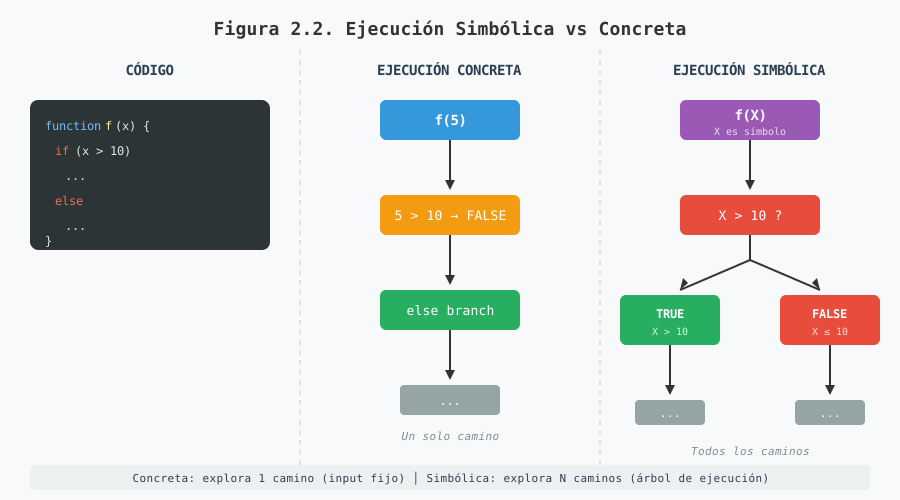
Symbolic execution treats inputs as symbols and explores execution paths (King, 1976). According to Mossberg et al. (2019), it is particularly effective for:
Figure 2.2. Concrete execution vs symbolic execution
Tools: Mythril (Mueller, 2018), Manticore (Mossberg et al., 2019), Oyente (Luu et al., 2016)
2.4.4 Formal Verification
Formal verification uses mathematical methods to prove program properties (Hoare, 1969). According to Tolmach et al. (2021), techniques applied to smart contracts include:
1. Model Checking: - Exhaustive state exploration - Temporal property verification - Tool: SMTChecker (Solidity; BMC and CHC engines)
2. Theorem Proving: - Mathematical proof of properties - Specifications in formal languages - Tool: Certora Prover
3. Bounded Model Checking: - Verification up to depth k - Balance between completeness and scalability - Tool: Halmos
Table 2.6. Comparison of verification techniques
| Technique | Soundness | Completeness | Scalability |
|---|---|---|---|
| Model Checking | High | High | Low |
| Theorem Proving | Complete | Complete | Medium |
| Bounded MC | Limited (k) | Limited (k) | High |
2.5 Software Design Patterns
2.5.1 Adapter Pattern (Gamma et al., 1994)
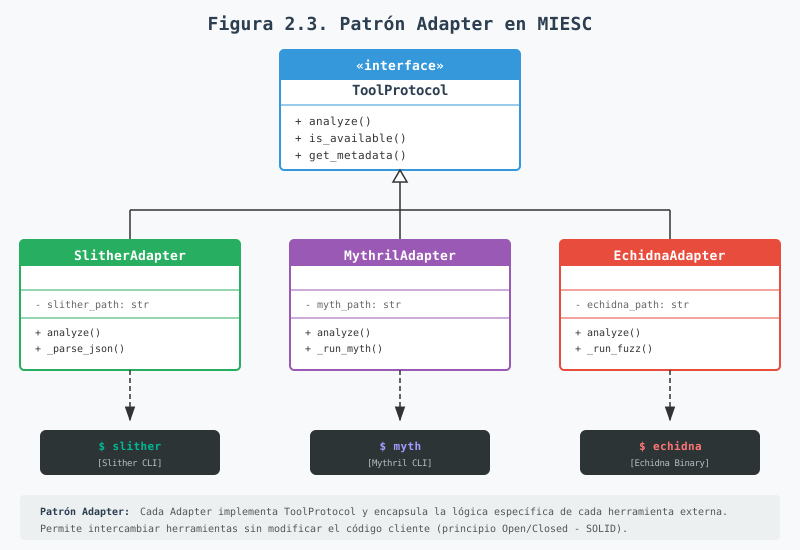
The Adapter pattern converts the interface of a class into another expected by clients. MIESC uses this pattern to integrate heterogeneous tools:
Figure 2.3. Adapter Pattern in MIESC
2.5.2 SOLID Principles
MIESC implements the SOLID principles (Martin, 2000):
| Principle | Application in MIESC |
|---|---|
| **S**ingle Responsibility | Each adapter handles one tool |
| **O**pen/Closed | Extensible through new adapters |
| **L**iskov Substitution | Adapters are interchangeable |
| **I**nterface Segregation | ToolProtocol defines minimal interface |
| **D**ependency Inversion | Dependency on abstractions |
2.5.3 Defense in Depth
Defense in Depth is a security strategy that employs multiple layers of controls (Ross et al., 2016). According to the definition in the United States national-security glossary, which NIST adopts in its publications (Committee on National Security Systems, 2015):
"Defense in depth is an information security strategy that integrates people, technology, and operations capabilities to establish variable barriers across multiple layers and missions of the organization."
Durieux et al. (2020) show empirically that no single tool detects all vulnerability classes and that combining complementary tools increases detection coverage, evidence that supports the defense-in-depth approach.
Figure 2.4. MIESC Defense-in-Depth Architecture
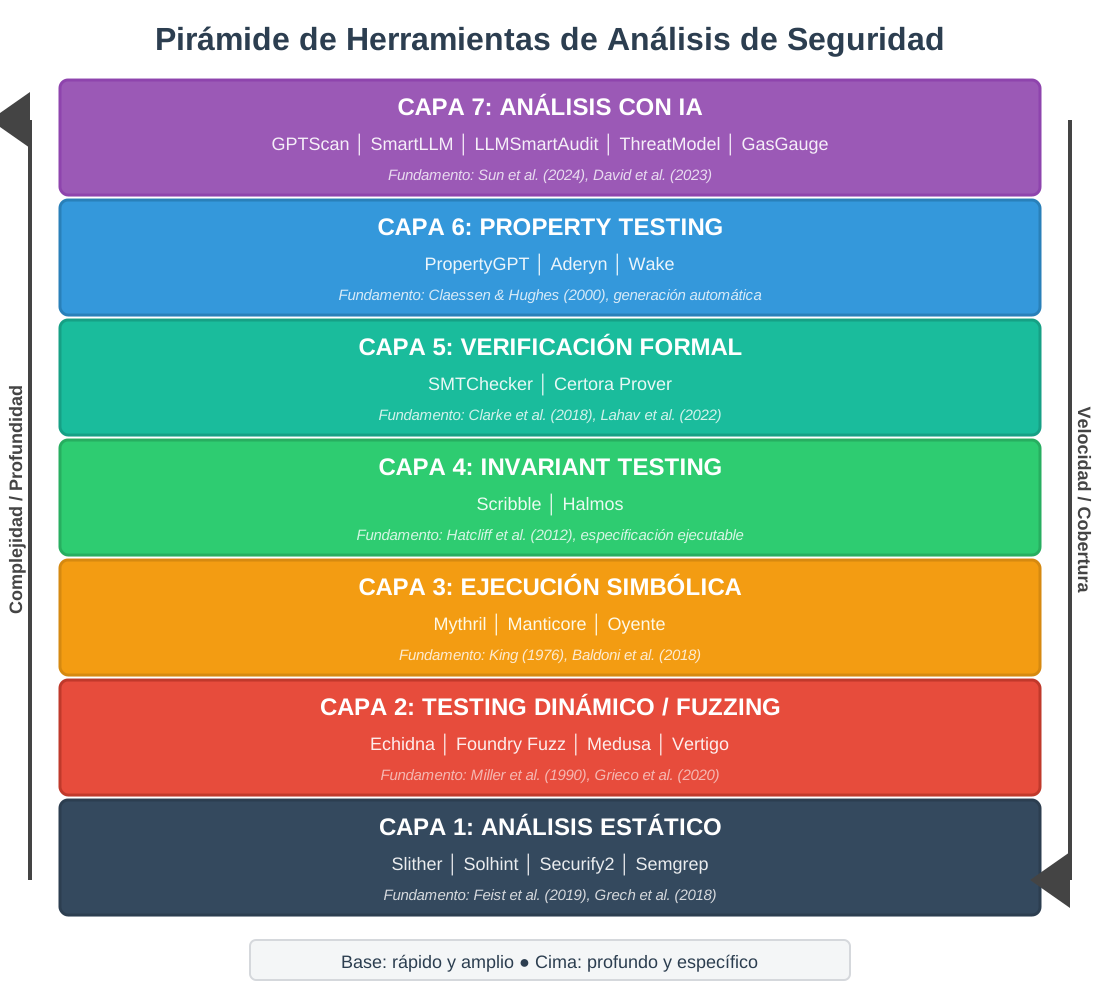
Principle: Each layer provides complementary protection. If one layer fails to detect a vulnerability, subsequent layers offer additional detection opportunities.
2.6 Artificial Intelligence in Cybersecurity
2.6.1 Large Language Models (LLMs) in Security
LLMs have emerged as powerful tools for code security analysis (Zhang et al.,2025). According to the systematic study by Hou et al. (2024):
"LLMs demonstrate emergent capabilities to detect vulnerabilities that escape traditional pattern-based tools, particularly those requiring semantic understanding of code."
Applications in smart contract security:
- Vulnerability detection: Semantic code analysis
- Property generation: Automatic invariant creation
- Finding explanation: Translation to natural language
- Remediation suggestion: Corrected code generation
Sun et al. (2024) report that GPTScan, which combines GPT-3.5-turbo with program analysis, achieves precision above 90% on token contracts and recall above 70% on logic vulnerabilities, as a complement —not a replacement— to traditional tools.
2.6.2 Retrieval Augmented Generation (RAG)
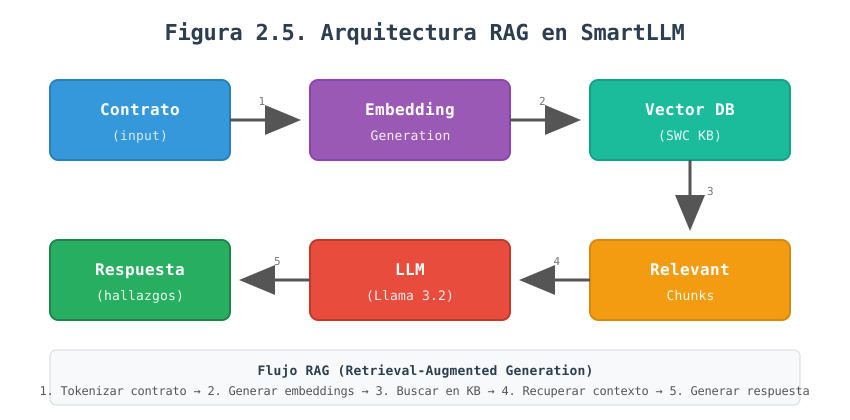
RAG combines LLMs with external knowledge bases (Lewis et al., 2020). In MIESC, SmartLLM implements RAG with a knowledge base of SWC vulnerabilities:
Figure 2.5. RAG Architecture in SmartLLM
2.6.3 Model Context Protocol (MCP)
MCP is an open standard for connecting LLMs with external tools (Anthropic, 2024). It enables:
- Tools: Functions that the LLM can invoke
- Resources: Accessible structured data
- Prompts: Predefined instruction templates
2.6.4 Data Sovereignty in AI
Data sovereignty is critical in cyber defense contexts (Floridi, 2020). The use of local LLMs through Ollama facilitates:
- Confidentiality: Code not transmitted to third parties
- Regulatory compliance: GDPR, LGPD, national regulations
- Operational independence: No dependence on external services
- Auditability: Full control over processing
2.7 Normalization and Taxonomies
2.7.1 Need for Normalization
Security tools use heterogeneous nomenclatures:
| Tool | Finding Name | ID | Severity |
|---|---|---|---|
| Slither | reentrancy-eth | - | High |
| Mythril | State change after external call | SWC-107 | Medium |
| Echidna | property_balance_invariant | - | FAILED |
Problem: Hinders correlation, deduplication, and prioritization of findings.
2.7.2 MIESC Normalization Schema
MIESC normalizes findings to a unified schema based on standard taxonomies:
{
  "id": "MIESC-YYYY-NNN",
  "type": "normalized-category",
  "severity": "CRITICAL|HIGH|MEDIUM|LOW|INFO",
  "confidence": "HIGH|MEDIUM|LOW",
  "location": {
    "file": "path/to/contract.sol",
    "line": 42,
    "function": "withdraw()",
    "contract": "VulnerableBank"
  },
  "classification": {
    "swc_id": "SWC-107",
    "cwe_id": "CWE-841",
    "owasp_id": "SC01"
  },
  "detected_by": ["slither", "mythril"],
  "message": "Normalized description",
  "recommendation": "Remediation suggestion"
}
2.7.3 Deduplication Algorithm
MIESC groups similar findings through:
- Location hashing: (file, line, function)
- Semantic similarity: Vulnerability type
- Clustering: Grouping by proximity
2.8 Chapter References
Aho, A. V., Lam, M. S., Sethi, R., & Ullman, J. D. (2006). Compilers: Principles, Techniques, and Tools (2nd ed.). Addison-Wesley.
Anthropic. (2024). Model Context Protocol Specification. https://modelcontextprotocol.io/
Atzei, N., Bartoletti, M., & Cimoli, T. (2017). A survey of attacks on Ethereum smart contracts (SoK). In International Conference on Principles of Security and Trust (pp. 164-186). Springer.
Chainalysis. (2024). The 2024 Crypto Crime Report. Chainalysis Inc.
Committee on National Security Systems. (2015). Committee on National Security Systems (CNSS) glossary (CNSSI No. 4009). CNSS. https://www.cnss.gov/CNSS/issuances/Instructions.cfm
Durieux, T., Ferreira, J. F., Abreu, R., & Cruz, P. (2020). Empirical review of automated analysis tools on 47,587 Ethereum smart contracts. Proceedings of the ACM/IEEE 42nd International Conference on Software Engineering (ICSE), 530-541. https://doi.org/10.1145/3377811.3380364
Feist, J., Grieco, G., & Groce, A. (2019). Slither: A static analysis framework for smart contracts. In 2019 IEEE/ACM 2nd International Workshop on Emerging Trends in Software Engineering for Blockchain (pp. 8-15). IEEE.
Gamma, E., Helm, R., Johnson, R., & Vlissides, J. (1994). Design Patterns: Elements of Reusable Object-Oriented Software. Addison-Wesley.
He, J., Balunović, M., Ambroladze, N., Tsankov, P., & Vechev, M. (2019). Learning to fuzz from symbolic execution with application to smart contracts. En Proceedings of the 2019 ACM SIGSAC Conference on Computer and Communications Security (CCS '19) (pp. 531-548). ACM. https://doi.org/10.1145/3319535.3363230
Hildenbrandt, E., Saxena, M., Rodrigues, N., Zhu, X., Daian, P., Guth, D., ... & Rosu, G. (2018). KEVM: A complete formal semantics of the Ethereum virtual machine. In 2018 IEEE 31st Computer Security Foundations Symposium (pp. 204-217). IEEE.
Hoare, C. A. R. (1969). An axiomatic basis for computer programming. Communications of the ACM, 12(10), 576-580.
Hou, X., Zhao, Y., Liu, Y., Yang, Z., Wang, K., Li, L., ... & Grundy, J. (2024). Large language models for software engineering: A systematic literature review. ACM Transactions on Software Engineering and Methodology. https://doi.org/10.1145/3695988
Ivanov, N., Li, C., Yan, Q., Sun, Z., Cao, Z., & Luo, X. (2023). Security defense for smart contracts: A comprehensive survey. arXiv preprint arXiv:2302.07347. https://arxiv.org/abs/2302.07347
Joint Chiefs of Staff. (2018). Cyberspace Operations (JP 3-12). U.S. Department of Defense.
King, J. C. (1976). Symbolic execution and program testing. Communications of the ACM, 19(7), 385-394.
Lewis, P., Perez, E., Piktus, A., Petroni, F., Karpukhin, V., Goyal, N., ... & Kiela, D. (2020). Retrieval-augmented generation for knowledge-intensive NLP tasks. In Advances in Neural Information Processing Systems, 33, 9459-9474.
Libicki, M. C. (2009). Cyberdeterrence and Cyberwar. RAND Corporation.
Luu, L., Chu, D. H., Olickel, H., Saxena, P., & Hobor, A. (2016). Making smart contracts smarter. In Proceedings of the 2016 ACM SIGSAC Conference on Computer and Communications Security (pp. 254-269). ACM.
Martin, R. C. (2000). Design principles and design patterns. Object Mentor, 1(34), 1-20.
MITRE. (2024). Common Weakness Enumeration (CWE). https://cwe.mitre.org/
Mossberg, M., Manzano, F., Hennenfent, E., Groce, A., Grieco, G., Feist, J., ... & Sloan, J. (2019). Manticore: A user-friendly symbolic execution framework for binaries and smart contracts. In 2019 34th IEEE/ACM International Conference on Automated Software Engineering (pp. 1186-1189). IEEE.
Mueller, B. (2018). Mythril: Security analysis tool for EVM bytecode. In DEFCON 26.
Nakamoto, S. (2008). Bitcoin: A peer-to-peer electronic cash system. https://bitcoin.org/bitcoin.pdf
National Institute of Standards and Technology. (2024). NIST Cybersecurity Framework 2.0. NIST.
OWASP. (2023). Smart Contract Security Verification Standard. OWASP Foundation.
Ross, R., McEvilley, M., & Oren, J. C. (2016). Systems security engineering: Considerations for a multidisciplinary approach in the engineering of trustworthy secure systems (NIST Special Publication 800-160, Vol. 1). National Institute of Standards and Technology. https://doi.org/10.6028/NIST.SP.800-160v1
Sayeed, S., Marco-Gisbert, H., & Caira, T. (2020). Smart contract: Attacks and protections. IEEE Access, 8, 24416-24427.
Smart Contract Weakness Classification. (2020). SWC Registry. https://swcregistry.io/
Sun, Y., Wu, D., Xue, Y., Liu, H., Wang, H., Xu, Z., Xie, X., & Liu, Y. (2024). GPTScan: Detecting logic vulnerabilities in smart contracts by combining GPT with program analysis. En Proceedings of the IEEE/ACM 46th International Conference on Software Engineering (ICSE '24) (pp. 1-13). ACM. https://doi.org/10.1145/3597503.3639117
Sutton, M., Greene, A., & Amini, P. (2007). Fuzzing: Brute Force Vulnerability Discovery. Addison-Wesley.
Szabo, N. (1996). Smart contracts: Building blocks for digital markets. Extropy, 16(16), 1-10.
Tolmach, P., Li, Y., Lin, S. W., Liu, Y., & Li, Z. (2021). A survey of smart contract formal specification and verification. ACM Computing Surveys, 54(7), 1-38.
Vidal, F. R., Ivaki, N., & Laranjeiro, N. (2024). OpenSCV: An open hierarchical taxonomy for smart contract vulnerabilities. Empirical Software Engineering, 29(4), Article 101. https://doi.org/10.1007/s10664-024-10446-8
Wood, G. (2014). Ethereum: A secure decentralised generalised transaction ledger. Ethereum Yellow Paper, 151, 1-32.
Zhang, J., Bu, H., Wen, H., Liu, Y., Fei, H., Xi, R., Li, L., Yang, Y., Zhu, H., & Meng, D. (2025). When LLMs meet cybersecurity: A systematic literature review. Cybersecurity, 8(1), Article 55. https://doi.org/10.1186/s42400-025-00361-w
References follow APA 7th edition format. All URLs were verified in November 2024.